Java History & Features
Java didn't start as a language for computers.
It started as a language for toasters, televisions, and remote controls.
That origin story explains almost everything about why Java is designed the way it is — and why it became one of the most successful programming languages ever created.
👉 What you'll learn here:
- ›How and why Java was created
- ›How it evolved from 1995 to today
- ›The core features that make it unique
- ›Why those features still matter for your career
🧘 This page is about history and concepts — not code.
You won't need to write or understand any Java syntax here. Just read it like a story. By the end, you'll understand why Java works the way it does — and that context will make every technical lesson after this easier.
The Origin — Project Green (1991)
In 1991, a small team of engineers at Sun Microsystems started a secret project called Project Green.
The goal had nothing to do with the internet or enterprise software.
The team — led by James Gosling — was trying to build software for consumer electronics: set-top boxes, interactive TV remotes, and smart appliances. The problem they kept running into was simple and frustrating:
Every device had a different processor. Every processor needed different code. Writing software that worked on all of them was nearly impossible.
Gosling's solution was to create a new programming language — one that could write code once and run it on any hardware, regardless of the underlying chip or OS.
He originally called it Oak — reportedly named after an oak tree outside his office window.
Oak never made it into consumer electronics. The interactive TV industry wasn't ready for it. The project almost died.
The Pivot — The Internet Changes Everything (1994–1995)
In 1994, the World Wide Web was exploding. Suddenly there was a new problem that looked exactly like the one Gosling had already solved:
Web pages needed to run interactive content on any browser, on any computer, on any OS — without knowing in advance what the user's machine looked like.
The team realized Oak was perfectly designed for this. They renamed it Java (reportedly inspired by Java coffee, a favorite in the office), adapted it for the web, and released it publicly in 1995.
The first major demonstration was a web browser called HotJava — it could run interactive Java programs (called applets) directly inside a webpage. For 1995, this was extraordinary.
Sun's famous tagline captured the idea:
"Write Once, Run Anywhere."
Within months, Netscape — the dominant browser of the time — agreed to include Java support. The language went from near-death to one of the most talked-about technologies in software almost overnight.
Java's Growth Timeline
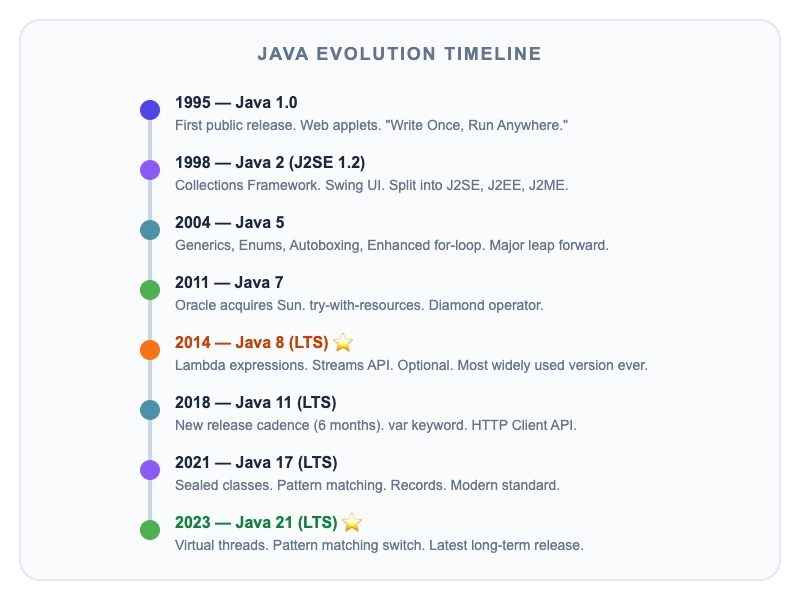
💡 What is LTS? LTS stands for Long-Term Support. Oracle provides security and bug fixes for LTS versions for several years. For production systems, companies always prefer LTS versions — Java 8, 11, 17, and 21 are the most widely deployed.
The Oracle Era — and the 6-Month Release Cycle
In 2010, Oracle acquired Sun Microsystems and took ownership of Java.
Some developers preferred open-source alternatives, which helped OpenJDK — the free, community-maintained implementation of Java — become widely popular. Most developers today use OpenJDK, and it is fully compatible with the official release.
Starting with Java 9 (2017), Oracle switched to a 6-month release cycle — a new version every six months, with LTS releases every few years. This made Java feel modern and actively evolving again.
🔗 Want to see what's new in specific versions? → Modern Java (8–21) covers the key features of each major release with examples.
The Core Features of Java
These are the properties that have defined the language since 1995 — and still do today.
Understanding these features helps you understand why modern Java looks the way it does — every design decision traces back to one of these core principles.
1. Platform Independence
Write code once. Run it on Windows, Mac, Linux, Android — without changing a single line.
This works because Java compiles to Bytecode — a universal format that the JVM translates for each specific OS at runtime, instead of compiling directly to machine code.
🔗 The full technical explanation: → How Java Works Internally
2. Object-Oriented
Everything in Java is organized around objects — self-contained units that combine data and behavior.
This mirrors how the real world works. A BankAccount object has data (balance, account number) and behavior (deposit, withdraw, transfer). Writing code this way makes large systems easier to design, maintain, and extend. It's also one of the most transferable skills in software — the same concepts apply in Python, C#, and Kotlin.
🔗 A full guide to OOP starts here: → Classes & Objects
3. Strongly Typed
Every variable in Java must declare its type:
1int age = 25;
2String name = "Arjun";
3boolean isActive = true;
The compiler catches type errors before your code ever runs — not after your app crashes in production. For interviews, it also means your code is more predictable and easier to reason about under pressure.
4. Automatic Memory Management
In languages like C++, you manually allocate and free memory. One mistake causes memory leaks or crashes.
Java handles this automatically through a Garbage Collector (GC). When an object is no longer needed, the GC reclaims its memory without any action from you — removing an entire class of dangerous bugs from the start.
5. Multithreaded by Design
Java was built with multithreading in the core language — the ability to run multiple tasks simultaneously within a single program.
When a server handles thousands of users at once, each request runs in its own thread. Java's threading model makes this tractable without needing external libraries.
🔗 Deep dive here: → Multithreading Basics
6. Secure by Architecture
The JVM acts as a sandbox between your program and the operating system. Java programs can't directly access memory addresses or hardware — all access goes through the JVM's controlled layer.
This architecture — originally designed for browser applets — still provides meaningful security guarantees in modern server-side applications.
7. Rich Standard Library
Java ships with thousands of pre-built classes covering data structures (ArrayList, HashMap), networking (HttpClient), file operations (Files, BufferedReader), date and time (LocalDate), and concurrency (ExecutorService).
Most things you need to build are already available. You write the logic; the library handles the plumbing.
Why These Features Still Matter Today
Java was designed in 1995 for a specific problem: software that runs the same way on any device.
That problem didn't go away — it grew. Today software runs on phones, tablets, laptops, servers, and cloud VMs, all with different hardware and operating systems. The features built to solve the 1995 problem are exactly the features that make Java reliable at the scale modern companies operate.
That's why a 30-year-old language still powers Netflix, Amazon, and some of the most critical enterprise and internet applications in the world.
💡 Why this matters to you: Understanding Java's history helps you understand why modern Java is designed the way it is. Every feature you'll learn — from OOP to Streams to threading — exists because of a deliberate decision made to solve a real problem.
Common Beginner Confusion
"Java versions are confusing — which one should I learn?"
Start with any modern version. The core language hasn't changed fundamentally since Java 8. Variables, classes, loops, and OOP work identically from Java 8 through Java 21. The differences are additional features layered on top — learn the foundation first.
"Is Java dying?"
No. Java consistently ranks in the top 3 most-used languages globally alongside Python and JavaScript. The Android ecosystem, the Spring Boot backend world, and decades of enterprise systems all depend on it — and it's actively evolving.
The 3 Things to Remember From This Page
- ›Java was created to solve a hardware fragmentation problem — and became one of the major technologies behind enterprise and internet applications worldwide
- ›The core features — platform independence, OOP, strong typing, GC, threading — were designed together and still define the language today
- ›LTS versions (8, 11, 17, 21) are what companies use — start on any modern version and your knowledge transfers completely
Summary
- ›Java was created by James Gosling at Sun Microsystems in 1995, born out of Project Green
- ›Designed for consumer electronics — then pivoted to the web when the internet exploded
- ›The core idea — Write Once, Run Anywhere — was revolutionary in 1995 and remains relevant today
- ›Oracle acquired Sun in 2010; OpenJDK became the free, widely-used open-source implementation
- ›A 6-month release cycle since Java 9 keeps the language modern and actively evolving
- ›Core features: platform independence, OOP, strong typing, automatic memory management, multithreading, security, rich standard library
- ›Java 8, 11, 17, and 21 are the LTS versions — most widely deployed in real systems
What to Read Next
| Topic | Link |
|---|---|
| How Java compiles and runs code internally | How Java Works → |
| What JDK, JRE, and JVM actually are | JDK, JRE & JVM → |
| Install Java and write your first program | Install Java & Setup → |
| Features added in Java 8, 11, 17, and 21 | Modern Java (8–21) → |
| Java vs Python vs C++ — which to choose | Java vs Other Languages → |